After 16 months of leading Australia’s digital transformation, I wanted to reflect on what we’ve learned and achieved to date.
The DTO made the case for digital transformation in the Australian government
All across government, public servants are starting to think differently about digital service delivery, putting the user first, thinking big, starting small and iterating quickly.
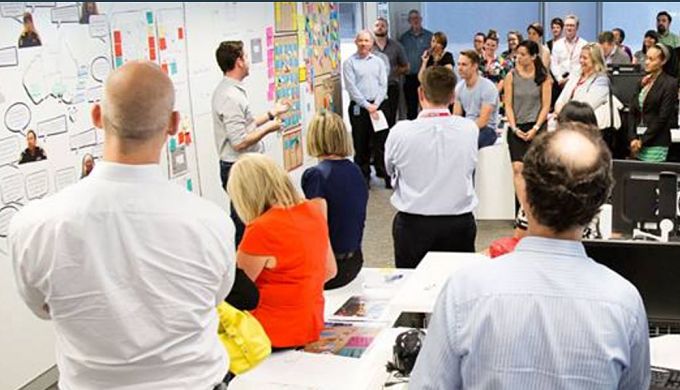
My team and I worked with departments, agencies and state governments to deliver six exemplar services – demonstrating what was possible. Like making it easier to book an appointment for your newborn baby’s immunisations. Making it easier for businesses to import goods that need a permit. Most of these teams had co-located with the DTO in our own delivery hubs, so we were all learning from each other, sharing our progress and research along the way.
I’ve been criticised on more than one occasion on the choice of problems we chose for the exemplars. The bottom line is, the problems chose us. Our criteria were simple: find a problem that could be clearly defined and leadership that was willing to work with us collaboratively.
Now that we’ve demonstrated the method, agencies can tackle any problem.
The DTO also worked to introduce common platforms to government, because platform design is essential to creating 21st century digital services for citizenry.
Sharing common platforms allows government agencies to stand on the shoulders of others, inside government and elsewhere. By identifying common features across myriad government services, they can be extracted out and opened up along with the user interface, the back office tools, infrastructure and data.
Adopting platforms means that the rest of government can make use of these commoditised “building blocks” for other services. This reduces duplication and cost, makes services more efficient, easier to update and refine and far quicker to build. It frees up the people building the services to focus far more on how citizens’ needs can be best met.
Our Common Platforms to date
We released the Digital Marketplace (which now has 42 opportunities, 252 approved sellers and 241 registered buyers) to begin transforming government ICT procurement. We created a Performance Dashboard, to make it easier to see how well government services are performing – with six services reporting so far – and we created cloud.gov.au,a platform to make it easy for government to take advantage of the cloud to operate digital services.
On top of this, we also built alpha prototypes of GOV.AU – a single website for government – and a digital identity platform. We developed these to demonstrate how such platforms could work, letting us test out the concepts with real users to find out if they could make people’s lives easier.
For a small agency – and one as new as the DTO – it was a tremendous achievement to have delivered so much and in so little time.
I’m very proud of the team and am grateful for the support of the departments and agencies that we partnered with.
All of this work helped prove to government that it really can deliver simple, clear, fast services that meet users’ actual needs, which, once we remove all the jargon, is really what “digital transformation” means.
We identified blockers to achieving transformation
The blockers to positive transformation are structural, cultural and skills-based. During the last 16 months at DTO and now at the brand-new DTA, we’ve also seen just how painful it can be for government to get on with delivering good digital services.
For services to be truly transformed, we need to go beyond the front end, and transform the back office IT too. If we don’t rethink the underlying IT systems and business processes, we’re constrained to do little more than make cosmetic changes. After all the service doesn’t stop at the user interface, it includes an ensemble of people, systems and processes that support it.
Unfortunately, across most governments worldwide – and Australia is no exception – too many public servants working in back offices are often reduced to human APIs – retyping information from one system to another, and stuck processing the repetitive common cases that shouldn’t need any human intervention at all. This is a waste of their talent and initiative.
“Whitehall fetishises the complex” – Mike Bracken, former GDS Executive Director, UK Government
All of their work is made more difficult by the astonishing complexity across government. I’ve sat in meetings where senior public servants search out the exceptions and the edge cases – at the expense of simplifying the common case, because they’re focused on the process rather than a better outcome.
The complexity is structural too. From the end user’s perspective – say, someone who wants to start a business – the set of interactions required to be compliant with government is often delivered by an assembly of different branches, agencies and tiers of government, and it’s very rare that any cog in the wheel sees the bigger picture.
Users get chucked from one to another as they move through a process. It is irritating and demoralising for people starting a business and it makes it so easy for them to fall through the cracks. No government wants to make it harder for people to start new businesses. It is heartening to see the Department of Industry Innovation and Science actively working towards improving the experience.
When dealing with government is too difficult and confusing for users to navigate online, it drives people to phone lines or forces them to visit a to visit a shopfront – both more expensive options. Too often, people are forced to pay professionals to deal with government for them.
When government is restructured by well-meaning politicians – and this happens often – IT systems often end up being passed from agency to agency. Over the last 40 years in Australia, this has created complex webs of systems that cost a lot to operate, and take a long time to change.
This creates a vicious cycle because, whenever a new policy needs to be implemented, it’s often easier to build a new system on the side, than it is to change the existing legacy system. So you end up with what we have now, unworkable and inefficient systems that meet outdated needs and are expensive and slow to change.
It’s just not that complex
When it comes to service delivery, the transaction volumes of government services are small compared to the wider world.
Government might think it’s huge, but its daily transaction volume is equivalent to just a few minutes of Twitter – or even less on the NASDAQ.
And still, government spends more than $16bn a year on IT. Our procurement and funding processes encourage big IT programmes, with bigger contracts. They drive a culture of blame aversion which creates the perverse outcomes and actually increases risk.
The history of the past several years of government IT failure is testimony to that. This is further complicated and exacerbated by the lack of technical and contract management expertise in government. (Too frequently, we actually ask vendors to tell us what they think we should buy.)
Government is one of the last industries that thinks it can outsource wholesale. Banks, brokerages and the insurance industry all made the shift twenty years ago, and have been able to transform their IT in the period since.
You don’t build digital services in the same way that you build bridges. How can you test with users, deliver a lean solution quickly, and iterate with what you learn, if you are forced to specify all your requirements upfront? When you’re locked in a big IT contract, changing what you’re building comes at a huge expense – in both cost and time.
We found that government has little visibility over the IT programmes that are already in flight. Without a single view of what’s going on, it’s hard to avoid duplication of effort, hard to see which programmes are going to deliver on time, and hard to intervene if something’s not working out.
We must build digital capability
One thing that’s been very clear from the last 16 months has been how dedicated Australian public servants are to doing their very best to serve their fellow citizens. I have met so many public servants here who are deeply committed to helping out those who need to get things done with government.
There is enthusiasm for digital. Transforming services makes it possible to free up the time of public servants so they can focus on dealing with the exceptional cases – where they can make the greatest impact. With technology that’s easier to modify and adapt, public servants on the front line can draw on their day-to-day experiences to design, test and deliver improvements to the services they operate.
There’s also a fear of digital. Over the last 40 years, as we’ve outsourced technology, there’s been a progressive deskilling of the public service. The reliance on consultants is remarkable and the amount spent on them is eye watering. That’s just not necessary if we re-skill the public service, which was one of the Prime Minister’s goals on establishing the DTO.
Digital transformation can seem daunting. It means challenging the status quo. It means getting closer to your users, being rigorous at measuring performance, and being honest about the things that aren’t working.
Government’s biggest challenge in the digital age is to completely upskill the public service so that it is well equipped to deliver the change that’s needed.
Marc Andreessen once said that “software is eating the world”.
In the age of Uber, Airbnb and Netflix upending traditional industries like taxis, travel agents and video, it’s an ever poignant reminder that not even government is immune to being transformed.
If people are embracing new services in the private sector, they will be increasingly intolerant of clunky 20th century service delivery by governments.
After 16 months, the Australian Government has recognised this new reality – the idea that government services must be transformed to be simple, easy and effective. While recognising an idea is an essential start to transformation, it is only the start. Implementation, execution and a willingness to monitor, refine and iterate depends on developing the “digital savvy”, the skills within and across all agencies and among agency leaders.
It’s a general law of sociology that every large bureaucracy seeks to maintain itself in its current form. And that means the institutional inertia against transformation is enormous. Changing government to operate at Internet speed and quality also requires strong will and expenditure of political capital from the nation’s leadership.
Without that mandate to change, it’s naive to expect an organisation that is very comfortable with its way of working to decide to spontaneously transform itself.
This is the challenge in the next 16 months – to double down on building the capability to deliver on the vision, and eliminating the blockers getting in the way.
Special thanks
The DTO and later the DTA attracted the very best talent the nation had to offer. People who were committed to the cause. They made great personal sacrifices of their time and talent and in some cases took substantial cuts in pay to join the team. To each and every member of the team, I offer my sincere thanks. You have much to be proud of.
I also want to thank the many public servants who opened their minds to the possibility of change and came on the journey. You have taken the very important step of beginning to transform the way services are delivered. I encourage you to continue to do just one thing – put users first, always.
My thanks also go to Mark Brudenell, Phil Thurbon, David Hazlehurst and the interim CEO of the DTA Nerida O’Loughlin for their valuable advice and encouragement.
And finally, I want to thank the Prime Minister, Malcolm Turnbull, for his unwavering support of our work. Without his vision and commitment to transforming public services, none of this would have been possible.
Paul
Paul Shetler was the CEO of the Digital Transformation Office and the Chief Digital Officer of the Australian Government’s Digital Transformation Agency.
Comment below to have your say on this story.
If you have a news story or tip-off, get in touch at editorial@governmentnews.com.au.
Sign up to the Government News newsletter